"Being together is like catching a sunbeam; each new memory we make reflects light hinting there is more to see and know."

July 19, 2015

Week 22 ~ Men of Faith, Commitment and Testimony

This blog represents more of the a "typical" week for us and our mission.  Not every week do we have the opportunity to spend our p-day visiting the many interesting places in this marvelous country of Peru.  Most of the days this week were spent planning for our "in country" meeting with our Peru Central AAAs. We did spend Tuesday evening, along with other, missionary couples, at a wonderful cultural event full of dancing and singing to celebrate the Peruvian Independence day.  We had a marvelous training meeting with seven amazing brethren from Iquitos, Huancayo, and Lima.  This now completes our nearly four months of training in four countries, including North and Souith Peru.
We have been enriched by these 35 wonderful brothers who are serving so faithfully, mostly on there own.  They are talented and knowledgeable, many of which are former stake presidents, mission presidents, and even area 70's.  We now enter the midyear audit cycle and then will begin planning our area wide training in December.  We are so thankful for the experiences we have had the past 5 1/2 months and await the next 6 months with wonder and anticipation.  

July 13, 2015

Week 21 ~ And God said, "Let the Earth bring forth every living creature . . . and it was so."

Actually, this has been a very average week and nice to stay at home but, then again, I guess nothing is very average with our mission although we get accustomed to the events of each day. We interact daily with the leaders of the area, the Area Presidency and 16 Area Seventies for the South America Northwest Area. We have wonderful and dedicated men who serve as area auditors. Our immediate supervisor is the Area Controller and also part of our office is the Local Unit Finance manager dealing with all the tithing and fast offerings and disbursements in the South America Northwest Area.

Also as part of our daily encounters, we associate and share with mission presidents, the MTC president, and temple presidents. In fact, the temple president for the new Trujillo temple we are very close to as they were the area auditors before us. We were at the grocery store the other night having taken a bus to get there, and the mission president got in line behind us and gave us a ride home. Our mission president President Boswell, is from Bentonville, Arkansas and Tessa knows of them although they left for their mission before Tessa moved there. When I visited Tessa in November, we actually went to the Boswell’s home so I even know where they live. We received a new Lima Central mission president this week, President and Sister Larson from . . . Caldwell, Idaho! They know Joe’s sisters very well!

We enjoy being with the other senior couples who are serving here. The Murrays are from Walnut Creek, California and we know so many of the same people and places. Brother Bill Murray serves as a real estate lawyer and Sister Billie Murray is writing up the history of the Saints in Peru. We love the Clarks, Ron and Bonnie, who are also from Eagle, Idaho, and also know Joe’s sisters very well. Here we are in Lima, Peru and it is just an extension of home.

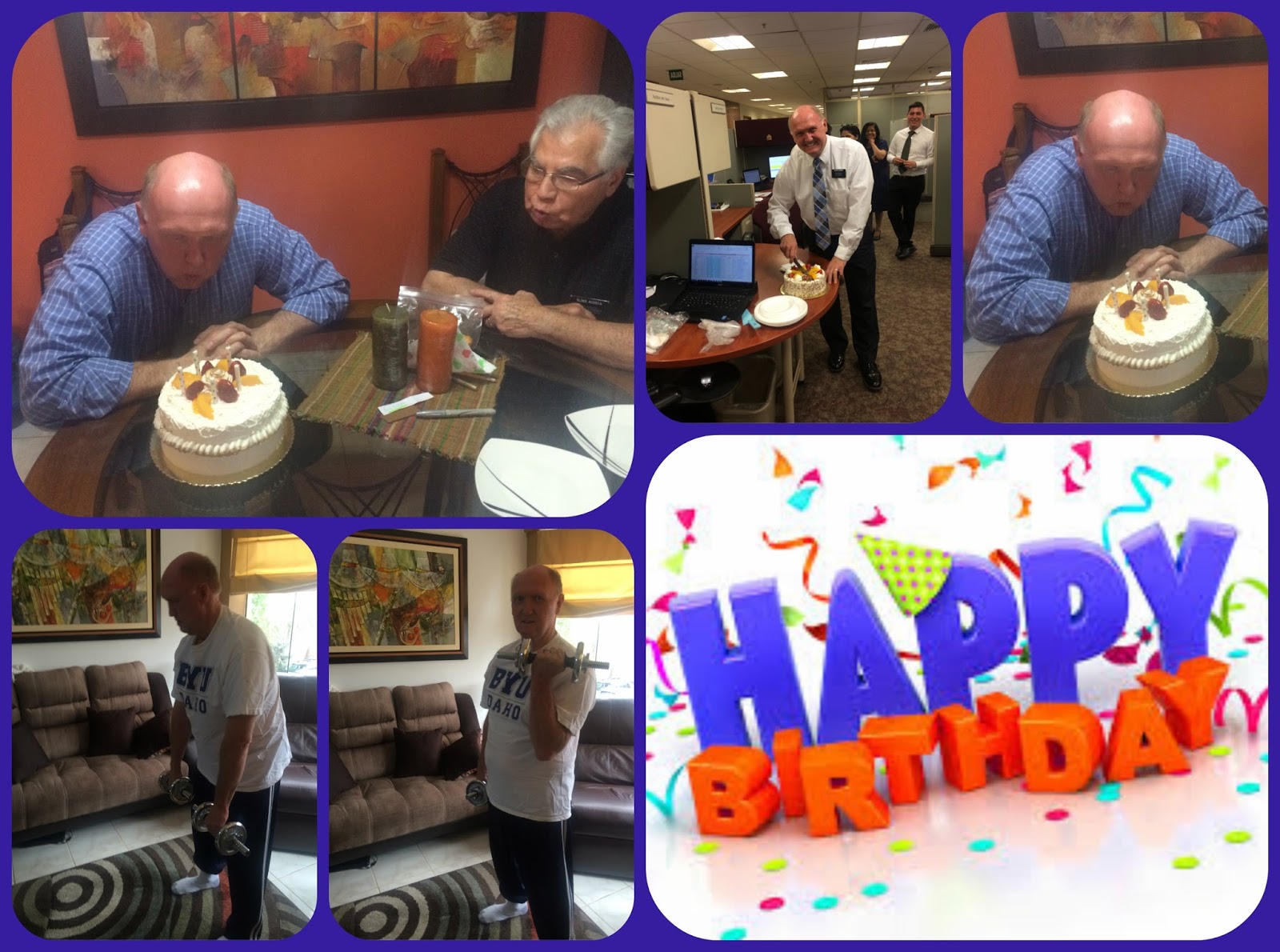
We celebrated Joe's birthday over the weekend with a party at the office and then more surprises for Joe at home, especially the weight set. He was so excited he immediately did a workout.


Joe and I went to the Parque de las Leyendas (Park of the Legends) which included the Lima Zoo. It was a beautiful day. We felt adventurous so we caught a bus right outside our apartment building and rode it all the way to the zoo, about an hour to downtown Lima. The park was very nice, not that there were a lot of animals but what they had was great. My favorites were the large variety of monkeys from the Amazon regions, some monkeys as small as a little kitten. They were so cute. They didn’t have the gorillas but many other varieties with funny faces, including the howling monkeys from Ecuador we heard but couldn’t see when we were there. Another highlight were the cats! They were beautiful, two white tigers, an orange tiger that really gave us a show, a pitch black panther, couger, leopards, and the most beautiful black jaguar we have ever seen, in addition to the beautiful traditional brown/gold jaguars. Wow. We also enjoyed the hippopotamus pool; they were so active and playful in the water. Of course, there were also amazing birds and other jungle animals. We really enjoyed our day there.


BUT, as part of the experience, the zoo is built around pre-Inca ruins, so we were able to see ruins that date before the Spanish conquest right in the middle of Lima. There were six huacas, ceremonial/burial centers. Since they were so close together, I just imagine they were families or tribes in each huaca but they all interacted together in trade, farming and hunting. Most of the huacas had restricted access by a main entrance with a walled perimeter. Because the climate here is so dry, these ruins survived even though they are made of handmade adobe bricks. There was a museum also that had artifacts found at these sites with explanations and models of the huacas. It was all quite a unique experience at the zoo.


It was nice to be at home for our weekend. There are many interesting places to see right here in Lima to visit on our days off. We hardly want to see a Saturday go by where we don't get out to explore the area around us. It is all so very unique.


July 1, 2015

WEEK 19 ~ Temple of the Mountain God vs.Temple of the Lord


Week 19 in the missionary lives of Elder and Sister Cheney began with preparations for our 6th country meeting.  We left Thursday early afternoon and flew up the coast to the second largest city in Peru, Trujillo, to meet with our AAAs. of northern Peru.  We were especially excited for this trip because we knew we would be able to see and experience the beautiful and newly dedicated Trujillo temple.    

We were so blessed to be able to attend the  temple.  It was absolutely stunning.  While in the celestial room, as I was sitting there waiting for Diane to enter, I was watching with silent interest, a scene unfold before me.  There were two Americans in the session with us.  They were both waiting for someone to come through the veil into the celestial room.  As I watched, several women began to slowly enter the room.  I didn’t realize at the time that the ones I was watching were sisters.  One was waiting for another and then when she entered they embraced and cried.  Then another and another and another entered the room and they all joined together in a tight circle hugging each other and weeping with obvious joy.  I just watched quietly, touched by their overwhelming happiness.  When it settled down and one of the American brothers was by himself, I approached him and asked him what the occasion was for so much joy and happy elation.  He told me the women were all sisters (5) and it was the first time they had all been together in over 40 years. He and the other man were married to two of the sisters and had come down to be with them in the temple and witness their wives and their sisters be sealed to their parents who had long since passed on.  I was touched and felt that this indeed was a heavenly scene that would be carried out many times in the spirit world as dear souls leave this world and enter another to join with their loved ones once again. 

Saturday was a special day for training.  All the brother AAAs were in attendance.  In fact Diane and I walked the short two blocks to the institute building from the hotel, arriving 10 minutes early and all of them were there waiting for us.  We were amazed.  It was a wonderful meeting to be with these dear brothers, Enrique Montoya (Trujillo), Oswaldo Mendoza (Trujillo), Jose Montalvan (Chiclayo), and Roberto Merrino (Piura).  We loved being with them and were able to get to know them and learn of their families and children and their employment and Church experience.  This is the best part of our mission, to be with and learn and love these dear brothers.  Each time we meet with another group of men it is the same.  Diane bore her testimony.  I was especially proud of her.  She is just getting better and better and more and more confident with her Spanish.  Her sweet words brought the spirit into the room and it remained for the entire meeting.   I introduced both of us and  spoke of our beloved spouses who had passed on  and of how we came to be where we are now.  I always love telling the story and it always brings a tender spirit into my heart.  We had a wonderful training being together all day. We ate together, took pictures, embraced and said farewells. We left with our hearts full of love for these good good men.  


Trujillo Cathedral next to our hotel at Plaza de Armas

Below are the excavations of the temples of the sun and moon built 1500 years ago. The temples are made with tens of thousands of mud bricks that didn't hold up under the elements of time, but the ruins are pretty amazing. These kinds of experiences are what we really enjoy seeing, Peru's past, certainly more than we're used to seeing in America.


I walked around the Plaza de Armas, took some pictures and then was waiting for Joe to finish up with his meetings. As I was sitting on a bench, a taxi pulled up and a young man got out and came up to me. He said he had seen my name tag and wanted to talk more, asked a few questions and was willing to give me his name, Franco, and number for the missionaries to contact. He spoke English very well but I just wanted Joe to be there.

The other young man we spoke with was our waiter at the restaurant in our hotel.  His name is Jackson.   At the time we were the only ones in the restaurant.  As he waited our table he took a moment and began asking us questions.  He wanted to know why we did what we did.  I explained a who we were and why we were on a mission.  I spoke of the temple to him and its purpose.  He knew about the temple being built and was very impressed with its beauty.  He has an 8 yr. old and his common law wife is ready to have a baby.  I gave him a pass along card and asked him if the missionaries could come by.  He agreed very humbly.   Now we have some follow-up we must do.  

The temple being built in Trujillo has had enormous and profound impact on this area.  When we checked out of the hotel Sunday morning, the receptionist told me how much she loved “our new building”.  She had gone to the open house (Las Puertas Abiertas).  She was so impressed.  She told me that now she is just waiting for the temple in Arequipa to have an open house in three years so she can go.  I didn’t have time to tell her she did not have to wait three years to go into the temple again.  These dear people are truly ready and waiting for the gospel.  We just have to open our mouths and share our testimonies. The new temple will be such a blessing for Trujillo.

We have two missionary couples leaving for home this week and they will be missed, Val and Julene Kendall and Greg and VevaSue Bart. Val and Julene were working with the ESL for the Latin missionaries, encouraging them to learn English as part of their missionary experience. Speaking English will provide more opportunities for success after their mission. Julene has worked with mission presidents, conducted surveys and sent monthly newsletters, and Val is a graphics artist and has created posters and flyers. Greg Bart is a doctor and provides health services for the missionaries throughout the area. VevaSue is his support companion, a down-to-earth American country girl.  Each of them served for 18 months and now we think, we have 18 months to go.

What a week we've had.  Now our travel is finished for a season.  We have one more meeting with our AAAs from central Lima on July 18th.  Our experiences throughout the Area have been incredible and life changing and we are happy we can share with you.


June 21, 2015

WEEK 18 ~ New Temples and Eternal Blessings for Peru


Arequipa, Peru
I know it seems like we are always playing on our mission .... not always.  However, because of our assignment as area auditors, we are required to travel throughout the area to meet with and train our 35 Assistant Area auditors in all five countries in the South America Northwest Area.  We finally were able to travel to the Southern half of Peru where we held another AAA training meeting in the beautiful, colonial, and historical city of Arequipa.  Before we met on Saturday, we spent two days in the old part of Arequipa, walking the four hundred year old cobble stone streets and visiting the many historical colonial buildings and cathedrals.  We felt the spirit of the area, especially as we gazed upon the breathtaking, panoramic view of three snowcapped volcanoes rising over the valley and city which was literally built from the white volcanic rock that once flowed from these three sister volcanoes. 

We stayed at the Hotel Casa Andina, a 1600's restored colonial mansion.  It is nestled in the heart of the colonial district and from where we took our daily walks to the places you see above.  The air was clear, crisp, and clean, quite a change from the current conditions in Lima.

We couldn't get enough of the unique blend of colonial Spanish and indigenous cultures.  It was absolutely amazing, a surreal combination of the ancient, the old, and the somewhat modern ... but not really.  Yes, hard to describe.  We did have a feel for the special pride the residents take in their city and surrounding beauties.


Our trip was especially "special" as we were given a guided tour of the valley of Arequipa by our dear brother Alejandro Nunez and his dear and kind wife, Mildred.  They took us to the other side of the valley where we  climbed a tower overlooking the green fields, blue skies and the three volcanoes.  We were able to see clear across the valley to the slopes of the Arequipa temple site. We then drove to the site and looked across the valley from the other direction from the temple site. It will be beautiful on the hillside under the shadows of the three volcanoes. Alejandro and Mildred are now and forever our friends, brother and sister.  Such good and humble people. Just today, we were blessed to attend the dedication of the new Trujillo temple in northern Peru. We will be there in Trujillo this coming weekend for training of the assistant auditors and will attend the newly dedicated temple on Friday.


One place we were told NOT to miss visiting was the Santa Catalina Monastery.  This really is a city within a city. At its height, the monastery housed approximately 450 people (about a third of them nuns and the rest servants) in a cloistered community. In the 1960s, it was struck twice by earthquakes, severely damaging the structures, and forcing the nuns to build new accommodation next door. There are approximately 20 nuns currently living in the northern corner of the complex; the rest of the monastery is open to the public.  We found the many arched paths and living areas fascinating.


We loved our trip to Arequipa, one of our “highlight” visits so far.  We want to return next year to experience more of this amazing valley in the ancient shadows of these towering, majestic 20,000 foot volcanoes.   Hasta que nos encontremos de nuevo. 

June 14, 2015

WEEK 17 ~ New Sights, Sounds, Smells, Savory Foods and Good People

This blog is kind of a continuation of last week since our trip included Bogota, Colombia. I just couldn't get it all prepared since there were so many pictures to organize. I hope you are enjoying our experience as we see such diversity in the different countries.

Bogota, Colombia


We had arranged for a bike tour for most of the day. It was not what I expected. I hoped to see some cathedrals, plazas and parks, but instead we rode through heavy traffic, streets and sidewalks full of holes, dirt and lots of people. Sometimes we were on the back roads, then it was more pleasant riding. The tour was a good history lesson on the troubles of Colombia. We saw the National University, lots of graffiti and painted murals everywhere on every bridge, wall, building or gate. 
We passed through the plaza where riots took place, a chocolate factory (but we couldn’t go in), a coffee factory with a little tour and time to relax in the café, and the busy market with every kind of fruit, vegetable, fish and meat you could imagine. That was the best part of the whole ride.


The tour guide was kind enough to mention to us that the tour included the red light district which we opted out of. One of the young guides took us around and back to the shop where we waited for our taxi. While we were waiting, Joe engaged in a conversation with Manuel Sanchez. It was obvious he was looking for truth and is searching different religions at this time. He spoke English pretty well and we told him of the Book of Mormon and the gospel of Jesus Christ. He knew of the Church and lived close to a building, so we encouraged him to check it out and learn from the missionaries what we believe. He said he would and Joe has his follow-up information. That was such a blessing to be with this young man having chosen not to follow the tour.

After the tour, we made a very quick clean up and change to attend the temple. It is a beautiful building and we enjoyed our session there. I listen to the endowment in Spanish and each time I attend, it is a little easier to go through the veil in Spanish. This time I didn’t have a help card and did okay. It was a beautiful experience and a quiet refuge from the crazy city of Bogota.

Our day Saturday started promptly at 7:30 when Jesus Lopez picked us up at the hotel. It was a very fine meeting with both the brothers from Colombia and those from Venezuela. As US citizens, we are not allowed in Venezuela because we probably wouldn’t get out alive. It is very dangerous there and the people blame their problems on the sanctions of the United States when actually it’s their corrupt government. Even Columbia has so many problems, but I found the brothers to be of strong faith and commitment to their testimony. They were a happy bunch and we had a great meeting and enjoyed lunch together.


The people of Colombia and Venezuela have a hard life! In Venezuela, there is a terrible shortage of food and the people are only allowed to shop one day a week, and that day has to correspond to the number of their ID card. When they shop they have to stand in line for at least two hours and then, when they get in the store, they are limited as to what they can buy. It doesn’t matter how much money you have, there is no food. Those with money hire a “line person” to stand in line for them. There are no Bishop’s Storehouses so the people have to help each other.


While the men finished the agenda items during the afternoon, I walked around the mall across from the hotel. This was bigger than any mall I’ve been in!! Four levels of shops, restaurants, a movie theater, banks, food court and a play area, all set up in a maze. I actually got all turned around and came out on the boulevard opposite the hotel. Even though most don’t have money and the country is in trouble, they sure have the fine clothes and other luxuries available at the mall. Our hotel was close to a university so we saw quite a young crowd, and all the women I saw wear the tight pants fitted into boots . . . every one! Here in Lima we don’t see many who smoke cigarettes but in Colombia, we saw it everywhere BUT it is still prohibited in the restaurants and stores.

We are having a wonderful time during our few months of travel. We have two more meetings in Peru requiring air travel, one to the north of Peru and one to the south. We are always glad to get back to our little apartment in Lima. We just feel really fortunate to be able to see other parts of South America, the people and culture!

June 7, 2015

WEEK 15 ~ Every day is a new journey


 Coming in on the plane, Quito, Ecuador is such a beautiful place, green and lush with lots of hills and mountains and farming. As soon as we got to the hotel and had a bite to eat, our AAA friend, Arturo Espinoza, came with his wife, Betty, and took us on an auto tour around town and up the hill to the Quito Penecillo with a complete view of the city at night. We are standing next to The Madonna statue overlooking Quito.  Tradition says she is the one that protects the city.  We, as Latter-day Saints, also remember and think this is a sacred place as it was the very spot where President Spencer W. Kimball stood and dedicated the land of Ecuador for the preaching of the Gospel on October 9, 1965. We enjoyed the friendship of the Espinosas as we spent the evening with them in this beautiful and significant capital city of Ecuador.  

 Basilica del Voto Nacional

The next day was even better as we went to the Basilica del Voto Nacional and even climbed the bell/clock tower there on the left all the way to the top. Phew! It really took our breath away with Quito at 9,000 feet. The church was started in 1883 and not dedicated until 1988. The construction continues and legend says when the Basilica is completed, the end of the world will come.

 Cruz Loma Tram
Betty Espinoza took us on the Teleferico tram straight up the hill where we enjoyed the site of Quito during the day spreading in every direction. The height was about 15,000 feet and quite cold with spectacular views. 
 
Presidential Palace
This palace is used as a home for the family when the cabinet meets or other political business. The presidential address given to the people is also given in this building. It was really nice to see the beautiful gifts on display throughout the rooms given to Ecuador from other countries. We even saw the crystal bowl as a gift from Hillary Clinton. The huge bouquets of beautiful roses, almost 100 roses in one vase, were incredible. Some of the arrangements were arranged with large pieces of driftwood. 


Center of the Earth, the equator just outside Quito. We went to the traditional monument which was quite uninspiring. It was pretty costly to get in but the monument was not much more than a monument and a lot of tourist shops. With a little detective work, we found another rival museum a short walk up the road, the Inti’ Ñan. We really liked that one with better displays and visual experiments to interact with the magnetic forces at work. It was pretty amazing. We saw a sink of water that swirled one way in the north hemisphere, on the line the water went straight down and, on the south of the line the water swirled the opposite direction. There were a few other experiments that defied gravity and reason because we were at the center of the earth.

The displays of tribal life at the Inti Nan represent the ancestral culture in Ecuador, that of the Waorani tribe and also the Quichua people. There are two pictures of real people as of the last five years, people who are currently living in the Amazon jungles of Ecuador. There were ritual artifacts on display as well as hunting, fishing and basic living tools.

June 6, 2015

WEEK 14 (continued) ~ "Where two or three are gathered together in my name, there am I in the midst of them." Matthew 18:20

This is a continuation of our trip to Ecuador last week. These blogs will also be used to create our mission book when we get home. We can't possibly share all our pictures but there are a lot of them here!


In conjunction with our meeting with the Assistant Auditors, we met at the Guayaquil temple for a session together. It was in Spanish but the spirit was great and the temple so beautiful. I went through the veil in Spanish. We met at the Kennedy Stake Center for our training meeting with left to right Richard Prado, Alturo Espinosa, Gustavo Villacres, and Carlos Purunacajas. We were staying at the Hampton Inn which was close to everything.

We walked to the Bolivar Park after church last week. That was a unique experience because it was full of iguanas, big ones, and they were very friendly. Many of the people were feeding them lettuce so it was fun to watch. We walked around the Metropolitan Cathedral which was typical of the Catholic churches. It was just loaded with beautiful flowers which are so plentiful here. The Metropolitan Cathedral was right across the street.
 
We walked up the hill Las Penas with 468 stairsteps to the top. There was a little lighthouse and small church at the top with a wonderful panoramic view of the city and river. It was pretty hard on Joe’s knees so I’m glad he was at least able to do it. It was a unique walk up with the little shops, residential houses and gardens, and cobblestone streets with art galleries. Joe bought a bottle of water at the top from a local street vendor. He was so thirsty I had to ask him if the bottle was sealed . . . it wasn't. Poor Joe, in the garbage can in went!
We went on a tour of the mangroves just south of Guayaquil. In the map at the top, the brown area is where the mangroves were. Also with us on our tour was Richard and Jo Webber. They were fun to be with! It was a great experience, first with a canoe ride along the river to see the birds and mangrove forests. The river empties into the Pacific Ocean so it rises and falls with the tide. One of the pictures above is a man coming out of the swampy jungle with a catch of crabs for the day which is when the tide is low. He has as many on his back as he has in the front. The crabs always leave a hole and the men just reach in and pull them out! It is unlawful to collect the females which is evident from the larger holes. Also in the little pictures is a wasp nest, a nest of baby rodents, a tarantula in a hole, our two guides Mario in blue and Jairo in white, mangos high in a tree, the mangled tree roots that fall out of the top of the trees, and a tree trunk that looks like a rose stem with thorns.  The second part of the trip was a hike in the beautiful jungle where we heard the howler monkeys in the trees but we couldn’t see them. They were very loud!

Week 14 ~ It is said that "man can't live by bread alone" ...... but chocolate sure helps


Hello all.  Sorry it's been several weeks since our last blog.  We had a ten day trip to Ecuador and Colombia for training with our AAAs in those two countries.  We wanted to begin this blog entry with our first stop  in Guayaquil Ecuador.   Come enjoy the journey with us!  In this blog section we begin with our trip to a small cacao finca where we met the Lara family of 10, 9 sons and a daughter, Ninfa, who is the "heart" of this delightful small family business.


Ninfa showed us her family cacao finca that was started with her grandfather.  Now she and her 9 brothers, father and mother run this marvelous 15 hectare (about 38 acres) family farm.  She showed us the process from start to finish of how they get from the planted seed to the finished chocolate.  In these photos we start with:
1. Planting of the best cacao seeds taken from the cacao pods on their farm
2. The seeds are grown in small black plastic bags that keep the seed warm and moist
3. The seed grows (in about 2 weeks) into a seedling which are sorted into the best of the best
4.  Can you guess how many seeds are planted during an 8 months period  ...... by hand?
     (over 100,000)
Here Ninfa is showing how they speed up the process of getting the cacao trees to produce fruit.  When her grandfather and then father began this cacao farm, it took four years for the seedlings to grow into a producing tree.  Some years ago Chinese came to the farm and asked if they could show the family how to "graft" small branches from mature producing trees into the seedlings.  They spent days "schooling" the family on the process.  Now these hybrid seedlings grow to mature trees in about a year.
 Once they reach maturity, cacao trees flower continuously during the entire year. The flowers of the cacao tree are tiny pink and/or white five-petaled blossoms. They are found on the trunks and lower branches of the tree, while in general, trees produce their flowers and fruit only on the smallest branches. Botanists refer to this phenomenon as cauliflory. Fewer than 5% of cacao flowers are pollinated.  These flowers can only be pollinated by small, gnat-like midges that can work their way through a cacao blossom's complicated parts.
It would seem that only 5% of the flowers producing fruit would not be very productive, however we learn that this is natures way of thinning the tree and allowing the "correct" amount of pods to grow, not burdening the tree with too much weight.  Even then workers need to prop the branches up to prevent them from breaking and destroying the tree.  Amazing how mother nature takes care of its own. 
Cocoa beans, the base for making chocolate, are the seeds of the cacao tree. They are found inside the cacao pods, surrounded by a sweet white pulp. Each pod contains between 20 and 60 cocoa beans. A variety of chemicals, including theobromine which is very similar to caffeine, give the seeds a bitter flavor. Beans can only germinate within 2 weeks of being harvested. When monkeys, birds, humans or other animals break open the pods to reach the delicious sweet pulp, they spit out the bitter-tasting seeds. This is the clever adaptation that the cacao tree evolved so that its seeds hit the forest floor and sprout into new trees.  We tried this sweet pulp.... yummy!
After showing us the orchard of cacao trees and pods, we were shown how they harvest the cacao beans and remove the pulp surrounding the beans.  Most of the pods on this farm are picked and then sold to larger companies that separate the beans and pulp.  The process of getting the cocoa bean to a dry state ready for grinding into chocolate is explained this way:
1.   Harvesting involves removing ripe pods from the trees and opening them to extract the wet beans. 
2..  The pods are harvested manually by making a clean cut through the stalk with a sharp knife    
3.   The pods are opened to remove the beans within a week to 10 days after harvesting. 
4.   The best way of opening the pods is to use a wooden club, striking the central area of the pod, causing it to split into two halves.  
 5.  After extraction from the pod, the beans undergo a fermentation and drying process. After 48 hours the pulp begins to separate from the bean.
 6.  The beans are left to dry and "die" at which point chemicals are released that allows for the breakdown of the cocoa bean. 
7.  When they are completely broken down through the fermentation and drying process they are ready for dry roasting. Here we see Ninfa's father, Estalin, with me stirring and heating the beans in a big cauldron.  
8.  When ready the beans were put into a hand grinder and at this point the pressure of the grinding made the beans release a dark chocolate paste, Estalin then mixed it with a little brown sugar and then made us some hot chocolate. Diane said it was the "BEST" Chocolate she had ever tasted.  

Estalin also was delighted to talk to us and told Diane and me, that we were the first Mormons ever to visit his finca.  We were honored to be his guests.  Maybe his little grandson will remember us happy gringos who loved his grandpa's cacao farm!

May 17, 2015

Week 13 ~ "I must be willing to give up what I am to become what I will be" Albert Einstein


We spent the day at the Larco Museum.  It was a marvelous display of the many different cultures that are part of Peruvian history through the ages.  It is supposedly one of the largest displays of antique pottery in the world and covers a time period of 2000 BC to 1500 AD.  It contains an amazing array of jewelry and accounting and numbering strings called “quipus.” The Inca could actually read these knotted strings like a book.  We were just so impressed and awed by the knowledge of these incredible cultures.  


Really, honestly, most of our weeks (about 80%) are spent doing the same thing over and over, get up, shower, read scriptures, have breakfast, couple prayer, walk the daily walk of “death” to the office.  If we want to get there the 5 minute route, which has been every time we have gone to the office, we walk along a narrow street which is probably the only street in all of Peru that doesn’t have a speed bump.  The traffic goes from a two lane to a four lane right in front of our apartment.  They hurry to try to get ahead of each other and then fly through this little opening where we walk at about 50 mph (no kidding).  There is construction on one side where we walk where they have tried to make a walking path with ……….. construction tape.  I kid you not.  It makes us feel perfectly safe and protected …. NOT! Then we get to another place where we have to wait for the traffic to pass and then make a mad dash to get around some bushes right next to the road.  We literally have to walk or run into the road to get past that point.  From there it is a short relaxed walk the rest of the way to the promised land.  Kind of like life.   But that is what we have to do if we want to make the quick five minute walk.  The other way takes about 15 minutes through quiet streets and a park, nice but not nearly an adrenaline rush.  
Our weeks keep us busy and our weekends make us look like we are really having fun, fun, fun …. Which we are!  We have also had some very tender experiences with the members and with non-members who we associate with on a daily basis. 
Like last week when we went to the Larco Museum in downtown Lima.  It takes quite awhile to get there… so we learned.  We decided to take a bus as far as Jocky Plaza, a popular and upscale shopping mall.  We thought we would be closer to downtown and that our fare would be half as much for a taxi from there.  The bus fare was 1 sole each (about 60 cents). We got off the bus and hailed a taxi and were told it would be about 20 soles.  Diane was not happy.  I really didn’t know how much it was supposed to cost.  Finally a lady came up to us and asked if we needed help, in English.  We told her our situation then she said, that’s a good price.  The taxi driver who wanted to take us drove up and said he would not cheat us and he really wanted to take us and that 20 soles was more than fair.  We got into the cab and he took us downtown.  We were pretty shocked to realize how far it was.  It was a lesson to us and especially a wonderful experience to speak to this good man who was driving and wanted us to know he was an honest man.  He really went out of his way and helped us understand better the taxi system and the distances and fares between different locations.

            During our ride, I began to talk with him about our mission and the Church, living prophets, and the Book of Mormon.  He had heard some about the Church and had friends who belonged.  He and his wife had just had a little baby girl several months before.  We talked about the eternal nature of the family.  He was very interested and touched.  It was a time I could have kicked myself for not having a pass-along card with me.  We exchanged information though.  He told me without any prompting that he would go to our Church the next day.  He lives a few blocks away from a chapel.  I had heard that promise before so I told him, “I know you are an honest man because you went out of your way to prove that to us today.  So when I ask you something and you say you will do it, I know you will keep your promise.  Will you go to the LDS Church tomorrow and will you seek the missionaries out and invite them to your home?”   He said “yes, I will do it.” I will follow up and see.  

May 10, 2015

WEEK 12 ~ Even if you're on the right track, you'll get run over if you just sit there

                                                           Train Trip to Huancayo


We caught the train to Huancayo Friday morning. The taxi picked us up at 5:30 and the train pulled out of the staion at 7:00. We were expected to arrive in Huancayo at 7:00 in the evening, a 12 hour train ride over the Andes Mountains BUT we didn’t get in until 10:30 at night. They served the passengers breakfast and lunch but no dinner. We ate all our snacks and played cards, the same game over and over.

The train ride was just great . . . for the first 10 hours. We went through 68 tunnels and numerous bridges, climbing in elevation to 15,680 feet! The views were pretty spectacular as we traveled through the canyons and over the mountains. The local villages and pueblos along the way only have the train come through once a month during the summer months so the people and children would wave to us from their doorways and windows. I can’t imagine living so close to the tracks!!  When we got to the top elevation, I would get woosy dizzy just standing up to take a picture out the window. Whew, breath deep. Unfortunately, it was too dark to see the little towns on the other side of the mountains which are part of the Huancayo mission. We’ll see them on our way home. We are taking the bus back to Lima tomorrow morning which is supposed to only take eight hours.


When we arrived at 10:30pm, there was still cultural dancers to greet us. In Mexico there would be a Mariachi band, in Italy some violinists, but here our greeting was a dance group symbolic of the African slaves who worked in the mines. Strange at such a late hour.


We stayed at a great resort in Huancayo located up on the hillside overlooking the city. We had a room like a little cottage chalet that was just delightful. The morning was glorious with blue skies and cool fresh air and pine trees. It was picturesque like being in the Austrian Alps, a huge difference out of Lima!


After a wonderful breakfast overlooking the valley, we went back into the city and checked into the Turismo Hotel. We spent the rest of the afternoon sightseeing, first to the silversmith and to the weaver’s shop. The owner shared with us the Quechua code of honor. Can you find the three ideals they live by? I bought a woven wall hanging that shows life in the Peruvian mountains to bring home.


My favorite part was to see the little Peruvian Quechua women in their native dress, multiple colorful skirts (polleras) of hand-woven wool cloth called bayeta, colorful shawl to carry their load or to carry children called k'eperina, a bowler hat, stockings and always long traditional braids. In the pictures below, notice how all the women have these long braids. Can you find the cow walking right across the street in town? How many dogs to you see with the woman waiting to cross the street? What do you think they carry in their back shawl? In the mountains, we didn't see any trucks, just bikes with these carts attached to carry large loads. In the field, do you see the women digging up papas (potatoes)?


Our last stop was to the gourd shop where we watched the old art of carving them. They showed us how they shaded and colored the designs with a burn stick. The harder they blew, the darker the colors. 


The other technique was to rub animal fat all over the carved design and then add a black paste that was made with grass reeds. After rubbing it on very well, wipe it off and the designs are highlighted. Fascinating! Can you tell which technique was used in the pictures?


Our tour guide took us to the Parque de la Identidad (Identity Park) made almost entirely with rock giving recognition to the great people of Huancayo. Actually, our gourd artist, Eulogio Medina who we had visited earlier in the day, was also honored at the park for his contribution in preserving the tradition of decorating gourds. His monument is the large gourd in the middle of a pond with a plaque to his name. It is a very beautiful park with walkways, fountains, bridges and gardens. In the bridge picture, you can see the stone castle in the back built for children to climb and explore. Visitors could also walk up and across the entrance gate looking over the entire park. It was wonderful with lots of water, music, flowers, children and benches for just sitting, reading, pondering or for the sweethearts who visit often. Ironic that such a beautiful park was surrounded on four sides by a dirt road full of potholes and no parking. Sad.


It was a wonderful trip. We love sharing with you the wonderful sites and experiences of Peru.